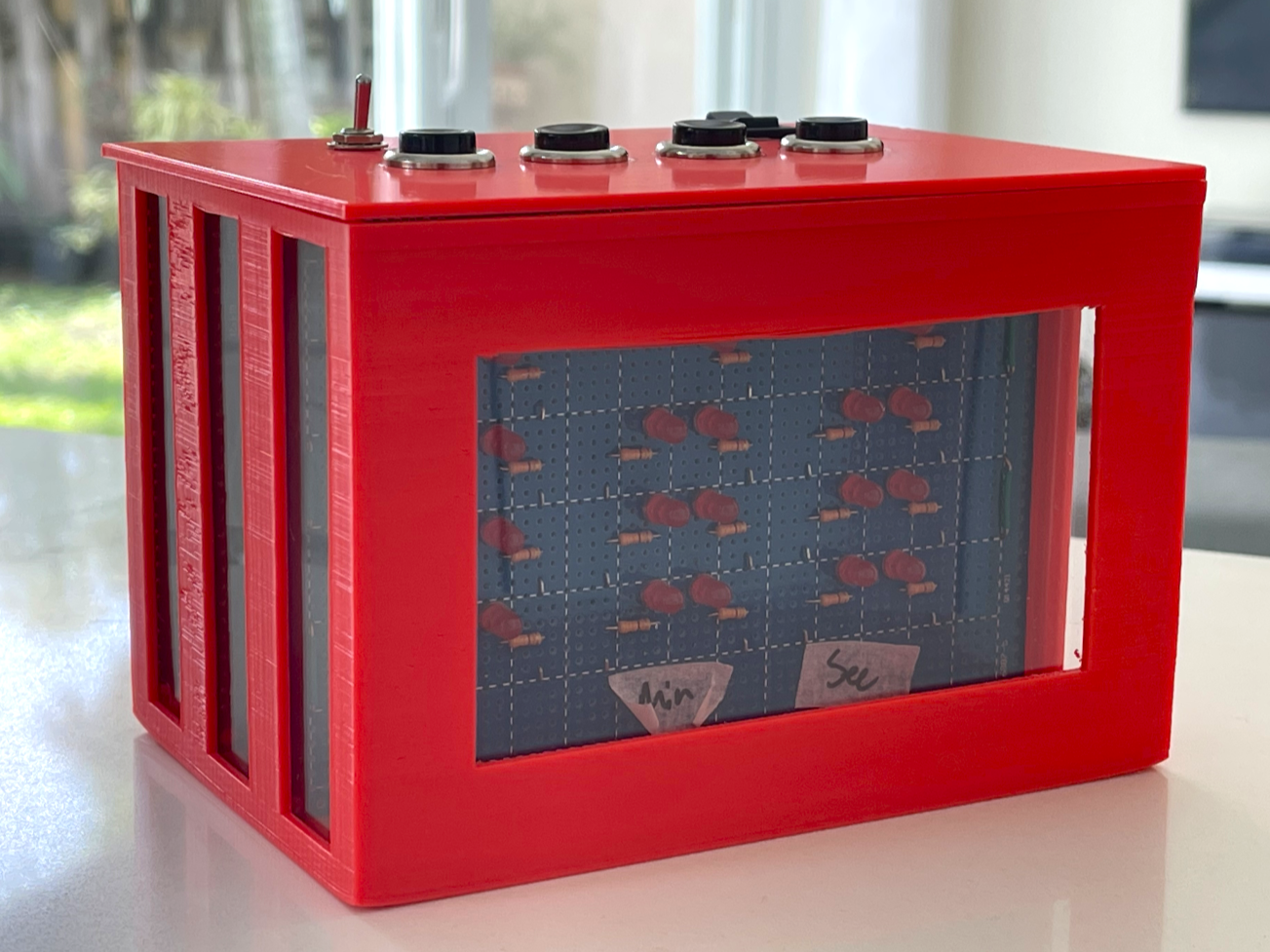
Binary Clock
A fully discrete binary clock built using 74LS-series logic and a crystal oscillator.
Tools/Technologies: KiCad / Fusion 360 / 74LS Logic / Crystal Oscillator / Through-hole Soldering / 3D Printing
Date: Spring 2023
Overview
This project is a fully discrete binary clock that uses 74LS-series logic chips, a 32.768 kHz crystal oscillator, and cascaded clock-division stages to produce a stable 1 Hz timing pulse. The divided pulse drives binary counters connected to multiplexers and decoders that display time through an LED matrix. The system operates from a 9 V battery and includes switches for power and manual time-setting, functioning similarly to a commercial digital clock.
The design intentionally avoids microcontrollers, demonstrating how fundamental synchronous logic can be used to implement real-time digital systems.
My Role
- Designed and 3D-modeled the entire enclosure using Fusion 360.
- Hand-soldered all components on a prototyping board, including LEDs, resistors, and 74LS logic ICs.
- Co-designed the logic system and wiring with one teammate, including counters, multiplexers, and the LED display arrangement.
- Integrated the crystal oscillator and clock-division stages, incorporating professor feedback on divider theory.
- Assembled and tested the full system to ensure stable long-term operation from a 9 V battery.
Technical Challenges
- Clock Division Accuracy: Achieving a clean 1 Hz signal required chaining multiple counter stages while managing propagation delay and ensuring synchronous behavior.
- LED Drive Constraints: Ensured proper current-limiting and avoided overloading 74LS outputs while maintaining uniform LED brightness.
- Switch Noise & Debounce: Manual time-setting introduced mechanical bounce, requiring careful wiring and filtering to prevent false increments.
- Perfboard Routing Density: Managing the physical layout of several counters, decoders, resistors, and LEDs on a compact perfboard required thoughtful routing to minimize interference.
Key Design Decisions
- Use of 74LS Logic: Selected to practice fundamental digital logic design instead of relying on a microcontroller.
- Crystal Oscillator Timing Reference: Provided long-term stability and eliminated drift inherent to RC-based timing.
- Custom 3D-Printed Housing: Improved structural rigidity, protected components, and added a polished appearance for portfolio use.
- Battery-Powered Operation: Kept the device portable and simplified power regulation for TTL logic.
Results / Outcomes
- The clock kept accurate time over long intervals until battery depletion.
- All counters, decoders, and display outputs performed reliably with no measurable drift.
- The enclosure successfully aligned the LED display and contributed to a clean, professional final product.
- Strengthened skills in synchronous logic, debugging hardware timing issues, and compact perfboard assembly.